




 Language
 English
 Español
HOT PRODUCTS
Content
Tap water is flat. Bottled sparkling water is expensive and wasteful. A carbonated water dispenser solves both problems — delivering fresh, fizzy water on demand without the recurring cost of single-use cans and bottles. But the category is broader than most buyers expect, ranging from compact countertop units to high-capacity undercounter systems built for hotel dining rooms. Choosing the wrong format means wasted counter space, under-delivered output, or an installation headache you didn't plan for.
This guide walks through everything you need to make the right call: how these machines work, which type suits your setting, what specs actually matter, and whether the investment pays off long-term.
What Is a Carbonated Water Dispenser and How Does It Work
A carbonated water dispenser is a point-of-use appliance that infuses filtered water with pressurized CO₂ gas on demand. Unlike a standalone soda maker where you manually carbonate a filled bottle, a dispenser connects to your water supply (or uses an internal reservoir) and delivers ready-to-drink sparkling water at the press of a button or tap of a touchscreen.
The process has three core stages. First, incoming water passes through one or more filtration layers — typically activated carbon, and sometimes ultrafiltration or reverse osmosis — to remove chlorine, sediment, and trace contaminants. Second, the filtered water is chilled to a set temperature in an internal tank. Third, CO₂ from a connected cylinder is injected under controlled pressure to produce consistent carbonation. The result: crisp, bubble-rich water with none of the plastic packaging overhead.
Most modern dispensers let you select carbonation intensity (light, medium, or strong) and output temperature (chilled, ambient, or hot), giving users a customizable experience that a standard bottled seltzer simply can't match.
Types of Carbonated Water Dispensers
Form factor is the first decision, and it should be driven by your available space, daily output volume, and whether you have plumbing access. Four main types cover the market.
Countertop Dispensers
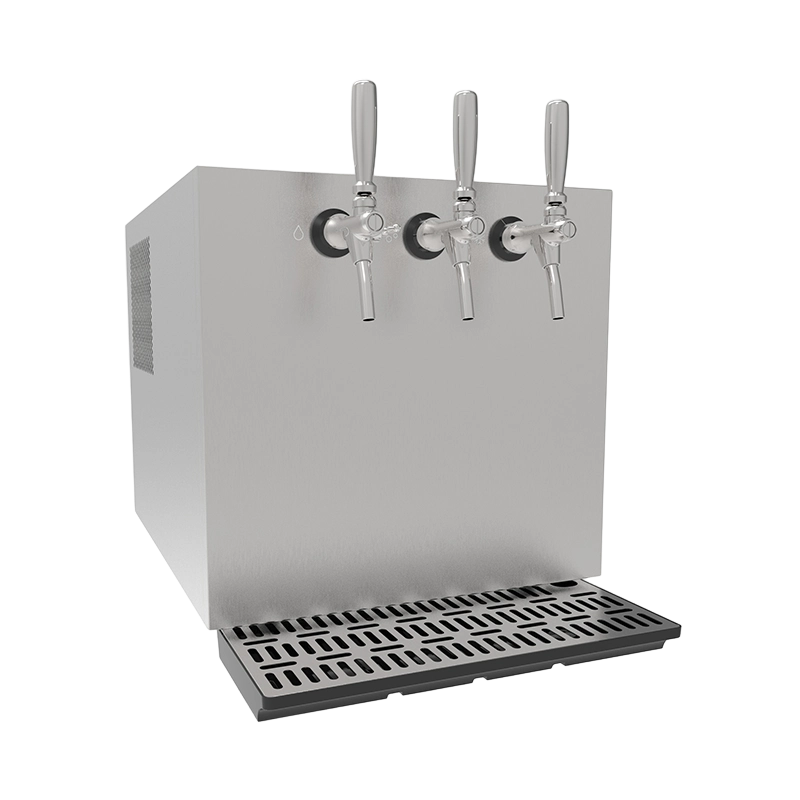
Countertop models sit on a bar, desk, or kitchen surface and are the most versatile entry point for both home and professional settings. They're quick to install — most require only a water line connection and a standard power outlet — and deliver output ranging from a few liters per hour in residential models to 60–150 liters per hour in commercial-grade units. If you're outfitting a café service counter or an office breakroom with limited floor space, this is the format to evaluate first. Browse countertop sparkling water dispensers for commercial venues to compare multi-tap and push-button configurations designed for high-turnover service.
Undercounter Dispensers
Undercounter units sit out of sight beneath a bar or countertop and connect to a separate dispense tower or tap above the surface. This format works best in environments where aesthetics and cleanliness matter — upscale restaurants, hotel bars, and premium office installations. Since the carbonation unit and CO₂ cylinder are hidden, the service area stays uncluttered. Capacity is typically higher than countertop alternatives, and the hidden plumbing makes the setup look intentional rather than improvised. For spaces that see steady footfall throughout the day, undercounter sparkling water dispensers for high-traffic spaces offer the throughput and durability to match. You can also review the complete buyer's guide for under-counter sparkling water units for detailed spec comparisons.
Floor-Standing Dispensers
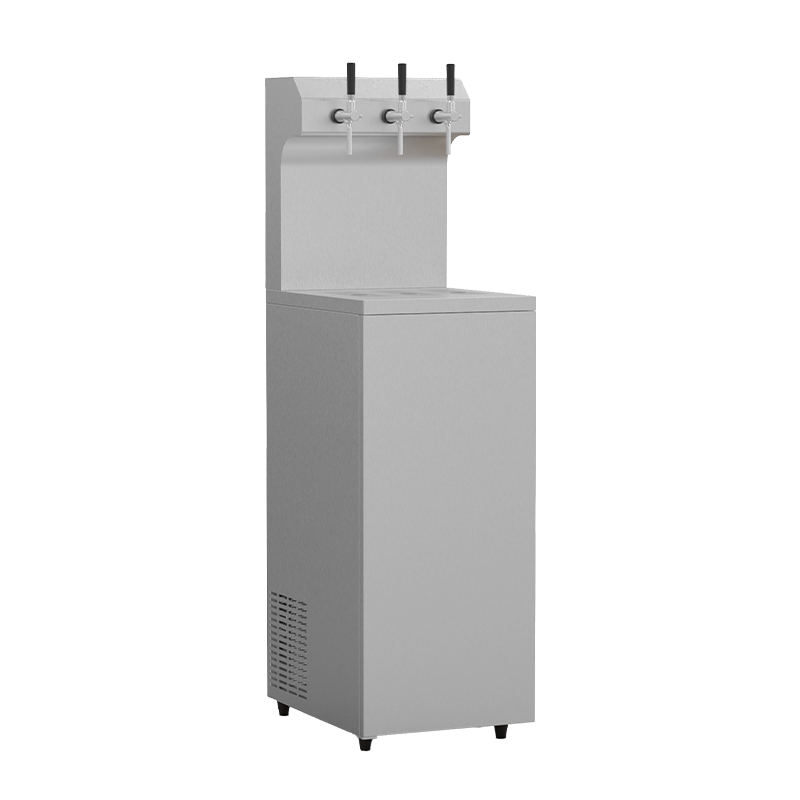
Freestanding models are self-contained towers that don't require counter or cabinet space. They're common in corporate lobbies, canteens, and large hospitality venues where the machine is a visible feature of the space rather than a hidden utility. Output capacity is typically the highest of any format, and many models include multi-faucet configurations that can serve sparkling, chilled still, and ambient water simultaneously from a single unit.
Wall-Mounted Dispensers
Wall-mounted units are a practical choice for tight footprints — school hallways, gym hydration stations, or compact HoReCa back-of-house setups. Because the unit is fixed to a wall, it doesn't occupy any floor or counter area, and accessible-design models can be positioned at wheelchair-accessible heights. This format is less common than the others but fills a specific gap where space is the primary constraint.
Key Features to Evaluate Before You Buy
Once you've identified the right form factor, these are the specifications that separate a dispenser that performs well from one that creates daily frustration. For a deeper look at how these features translate across still and sparkling models, the still and sparkling water dispenser comparison guide provides useful side-by-side context.
Carbonation Level Adjustment
Not everyone likes the same intensity of fizz. Entry-level dispensers offer a fixed carbonation level; better models provide at least two or three settings (lightly sparkling, sparkling, and strongly sparkling). In a commercial environment, adjustable carbonation significantly expands your appeal to different customer preferences without requiring a second machine.
Filtration System
The quality of your output water depends entirely on what happens before carbonation. Activated carbon filtration handles chlorine and taste issues. Ultrafiltration (UF) removes bacteria and fine particles. Reverse osmosis (RO) provides the deepest purification, removing heavy metals and PFAS compounds, though it generates some wastewater and reduces flow rate. Match the filtration level to your local water quality — areas with hard or chemically treated water benefit most from multi-stage systems.
Output Capacity and Recovery Time
Rated output in liters per hour tells you the machine's ceiling, but recovery time — how quickly the chilled tank refills after a burst of dispensing — tells you how it handles real usage patterns. A dispenser rated at 60 L/h but with a slow recovery cycle will underperform during a busy lunch service. Always check both figures.
CO₂ Cylinder Efficiency
A standard CO₂ cylinder produces roughly 60–100 liters of carbonated water per kilogram of CO₂, depending on the machine's injection efficiency and chosen carbonation level. Higher-efficiency dispensers extend the interval between cylinder changes, which reduces both operating cost and service interruptions — a meaningful consideration in commercial environments.
Noise Level and Cooling System
Compressor-based cooling is more efficient but louder; dry-cooling (fan-based) systems are quieter but slightly less effective in warm environments. For open-plan offices or dining rooms where ambient noise matters, a dry-cooling model or a unit with acoustic dampening is worth the additional investment.
Installation and Plumbing Requirements
Most commercial dispensers require a direct water line connection and a standard 220V outlet (or 110V for smaller units). Reservoir-based models offer flexibility where plumbing access is limited. Confirm the CO₂ cylinder size the unit accommodates — larger cylinders mean fewer changeovers but require storage space.
Home, Office, or HoReCa: Choosing the Right Fit
The same machine that works perfectly in a home kitchen may be undersized for a busy café, and a high-capacity commercial unit will be overkill — and overpriced — for a private residence. Here's how to match the dispenser category to the actual use case.
Home Use
Household demand is low to moderate: typically a few liters per day for a family. The priorities here are compact footprint, quiet operation, and ease of use. A countertop model with a built-in reservoir (no plumbing required) covers most home needs. Features like adjustable temperature and multi-mode output (sparkling, still, and ambient) make the machine more versatile for cooking, drinking, and entertaining. Explore home sparkling water dispensers designed around household footprint and convenience.
Office Use
Office environments need consistent throughput across peak usage windows — typically morning arrival, lunch, and mid-afternoon. A countertop or undercounter model with a direct water line connection and a cooling capacity above 30 L/h handles most small-to-medium teams. For larger organizations, floor-standing models with multiple output modes reduce queue time. Beyond convenience, having sparkling water readily available at the office has measurable effects on hydration habits — and well-hydrated staff consistently report better focus and energy. See the full range of office sparkling water dispensers organized by capacity and format.
HoReCa (Hotels, Restaurants, Catering)
Commercial hospitality settings demand the highest output volume, the cleanest aesthetics, and the most reliable service record. Undercounter models with sleek dispense towers are the standard for table-service restaurants. High-volume countertop multi-tap units suit buffet counters and hotel lobby stations. Durability, NSF/CE compliance, and easy serviceability are non-negotiable. For category-specific guidance, the sparkling water systems built for restaurants covers selection criteria and service considerations in detail.
Health and Sustainability Advantages
The case for switching from bottled sparkling water to a dispenser isn't just economic — the health and environmental arguments are well-documented.
On the health side, carbonated water hydrates as effectively as still water. Research published by the American Heart Association confirms that sparkling water contributes fully to daily fluid intake, with clinical experts noting it is broadly beneficial for total hydration. Beyond hydration, carbonation has been shown to support digestion and increase feelings of fullness compared to still water — a useful characteristic for those managing caloric intake. Clinical sources including University Hospitals note five documented benefits of sparkling water, from bone mineral support (natural mineral content) to constipation relief. Plain sparkling water — no added sugars or sodium — poses no risk to dental enamel, making it a sound daily choice for most people.
The sustainability argument is equally strong. A single commercial-grade dispenser can eliminate thousands of single-use plastic bottles and aluminum cans annually. CO₂ cylinders are refillable and recyclable. For businesses with sustainability commitments, replacing bottled beverages with an on-site dispenser reduces procurement logistics, waste volume, and carbon emissions from packaging and transport — all simultaneously.
Is a Carbonated Water Dispenser Worth the Investment?
The upfront cost of a quality carbonated water dispenser ranges from a few hundred dollars for a home countertop unit to several thousand for a commercial undercounter system. The question is whether that investment recovers quickly — and by almost every scenario, it does.
Consider a mid-sized office consuming 50 cases of bottled sparkling water per month at roughly $30 per case. That's $1,800 per month, or $21,600 annually, on water alone — before accounting for storage, ordering overhead, and disposal. A commercial dispenser at that scale typically recoups its purchase price within six to twelve months. After that, the only ongoing costs are CO₂ cylinder refills and periodic filter replacement, which amount to a fraction of the bottled alternative.
For restaurants, the math is even more compelling. Premium sparkling water served at table can be sourced at cents per liter through an on-site dispenser and charged at menu price — a margin opportunity that bottled purchases don't offer.
| Cost Category | Bottled Water | On-Site Dispenser |
|---|---|---|
| Product / water cost | $18,000–$24,000 | $300–$600 (filters + CO₂) |
| Storage & logistics | $1,000–$2,000 | Minimal |
| Waste disposal | $500–$1,000 | Near zero |
| Equipment (amortized) | $0 | $600–$1,500/yr |
| Estimated total | $19,500–$27,000 | $900–$2,100 |
Home users see a similar pattern at smaller scale. A family buying six to eight cases of sparkling water per month can recoup a quality home dispenser in under a year, then enjoy ongoing savings with virtually no behavioral change required.
The investment calculus is straightforward: the longer you've been buying bottled sparkling water, the faster a dispenser pays for itself. The only meaningful variable is choosing the right model for your volume and setting — which is exactly what the sections above are designed to help you do.


 ADDRESS
 CONTACT
 EMAIL
EMAIL